
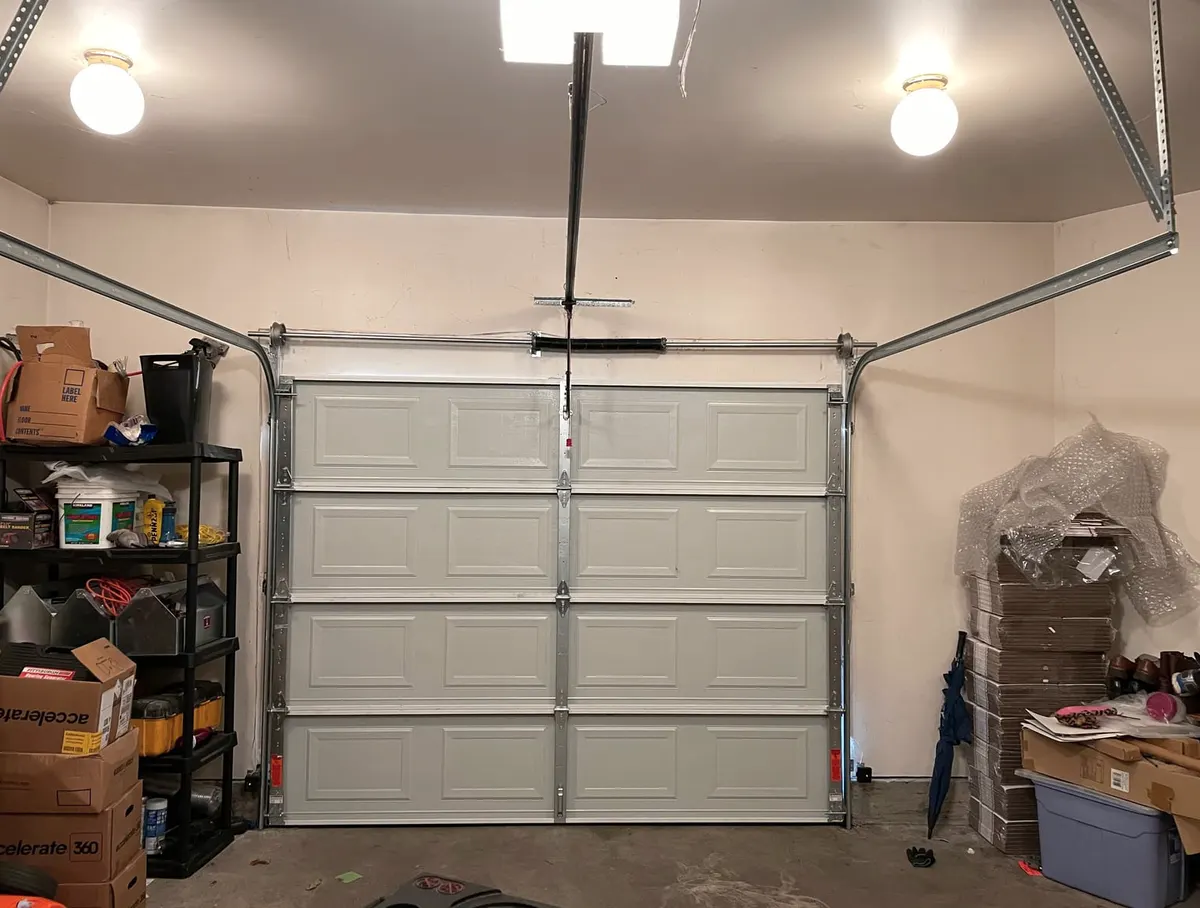
Short answer: a general home inspector checks that the door opens and closes. That's it.
Most standard home inspections treat the garage door as a pass/fail item: does it go up, does it go down, is there a working opener. That's often where the inspection ends. It won't tell you if the springs are near the end of their life, whether the cables are fraying, or if the auto-reverse safety feature actually works. Those are the things that turn into a service call — or a safety issue — a few months after you move in. Here's what to check yourself, and what it means if something fails.
The Walk-Through Checklist
1. Look at the springs
There are two torsion springs mounted on a bar above the door, or stretched side-springs along the upper tracks. Look for gaps in the coils, rust, or a spring that looks visibly stretched compared to its neighbor. If this fails: springs have a rated life cycle and age with use, not with the calendar. A worn spring can snap without warning, and a door with a broken spring won't open safely, sometimes at all. This is one of the more common repairs on older homes in this area, and it's worth knowing the springs' condition before you're the one who hears the bang.
2. Check the lift cables
These run alongside the springs, attached to the bottom brackets of the door. Look for fraying, kinks, or rust at the drum where the cable winds. If this fails: a frayed cable can snap under tension, and a door can drop unevenly or jam partway. Cables and springs are a paired system — if one looks worn, assume the other is close behind.
3. Test the auto-reverse safety feature
Place a 2x4 flat on the ground where the door would close, and run the closing cycle. The door should reverse when it touches the board. Also check the photo-eye sensors near the bottom of the tracks — they should be aligned and free of dust or cobwebs. If this fails: this is a genuine safety issue, not just an inconvenience. Misaligned sensors are common after any bump to the track, and a door that doesn't reverse on contact is a liability with kids, pets, or parked cars in the way.
4. Check the rollers and tracks
Rollers should be smooth, not cracked or flattened on one side. Tracks should be straight, with no dents or separation from the wall brackets. If this fails: worn rollers cause the grinding or rattling noise you hear on opening, and bent tracks make the door bind, which strains the opener motor. In homes with older housing stock, tracks installed decades ago may simply be due for replacement rather than repair.
5. Inspect the panels for rust, warping, or water staining
Run your hand along the bottom panel and look at the inside face of the door for water lines or rust streaks. If this fails: this usually points to drainage issues at the slab or gaps in the weatherstripping that let heavy rain wick up into the panel. Left alone through another wet season, this leads to swelling, rust-through, or a door that no longer sits flush.
6. Check the weatherstripping and bottom seal
Look at the rubber seal along the bottom of the door and the vinyl strip along the sides. It should be pliable, not cracked or torn away from the track. If this fails: gaps here let in wind-driven rain, let cold air into the garage ahead of the first hard freeze, and give pests an easy way in. It's a cheap fix if caught early, and a bigger one if ignored long enough that water starts reaching the slab or panel.
7. Test the wall button and remote, and check for a battery backup
Press the wall-mounted button and a remote separately. Ask whether the opener has battery backup — useful information given how often coastal storms here bring outages along with the rain. If this fails: an opener with no backup means a storm that knocks out power also locks you out of the garage until you find the manual release.
8. Check the slab and foundation line at the base of the door
Look for cracks, uneven settling, or a slab that pitches toward the garage instead of away from it. If this fails: this isn't a garage door problem on its own, but it affects how well the door seals and drains, and it's worth flagging separately in the inspection report.
9. If the property has a gate, check it separately
Gates are rarely part of a standard home inspection at all. Check the hinges, the motor (if automated), and whether it latches fully. If this fails: a gate that doesn't latch is a security gap, and a struggling gate motor on an older property may need more than a quick adjustment.
When to Call Middletown Garage & Gate
If you walk through this list and find aging springs, a track that's seen better days, or an opener that's missing basic safety features, it's worth getting a second opinion before you close or shortly after you move in. Our team handles spring replacement and garage door repair for exactly these situations, and we offer preventive maintenance visits that catch the smaller issues — a misaligned sensor, a worn roller — before they turn into an overnight repair call.
If you're buying a home in Middletown, Townsend, Odessa, Smyrna, Clayton, Bear, Newark, or Dover and want a second set of eyes on the garage door before closing, give Middletown Garage & Gate a call. We'll walk the door with you and tell you plainly what's fine, what's worn, and what needs attention first.